
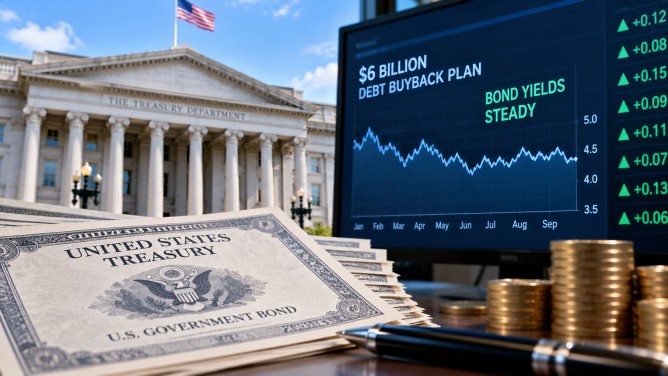
The U.S. Treasury’s recent initiative to mitigate borrowing costs by repurchasing $6 billion in U.S. Treasury securities has faced resistance from the bond market, as yields on government bonds continue to rise. Despite Treasury Secretary Scott Bessent’s announcement of the buyback on Wednesday, intended to quell a selloff that has been driving interest rates up, the measure did not ease investor concerns. Consequently, the yield on 10-year Treasury bonds has surged to its peak in three years.
Notably, the yield on 30-year Treasury bonds has escalated to approximately 5.2%, marking its highest point since the 2008 financial crisis. Investor anxiety is being fueled by ongoing inflation and the uncertain situation regarding the conflict in Iran, which is exerting additional pressure on U.S. government debt, traditionally seen as one of the safest investments globally. Although Bessent revealed in August that the Treasury planned to significantly increase its debt buyback operations to stabilize the market, yields have nonetheless been rising since the announcement.
The U.S. government’s debt exceeded $40 trillion in August, having doubled over the past ten years. The increase in Treasury yields could lead to higher borrowing costs for consumers, impacting rates for mortgages, student loans, and auto financing. This situation is further complicating matters for the U.S. Federal Reserve, which is grappling with elevated inflation levels. While annual inflation reached a three-year high in May, it slightly eased to 3.4% in July, yet remains 0.7 percentage points higher than the same period last year, with surging energy costs contributing to the inflationary pressures.
Adding to the economic concerns are rising oil prices, with Brent crude surpassing $100 a barrel on Wednesday amid intensifying conflict in the Middle East. This situation presents a complex challenge for the Federal Reserve, which must balance the need to control inflation through interest rate adjustments while also responding to political pressures. President Donald Trump has consistently advocated for lower rates, further complicating the Fed’s decision-making process.