
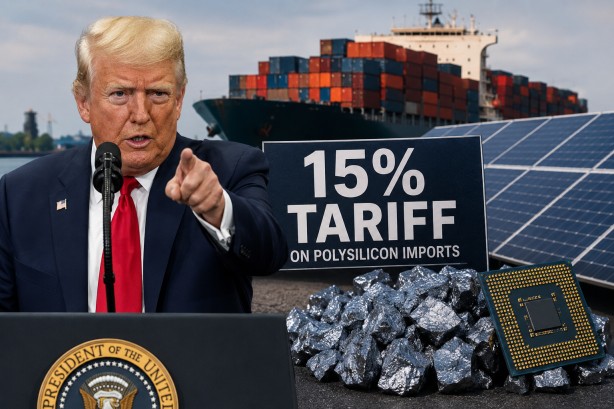
In a move to bolster domestic manufacturing and reduce dependency on Chinese imports, President Donald Trump has enacted a 15% tariff on products made with polysilicon, an essential component in semiconductor manufacturing and solar panel production. This tariff is set to be implemented on December 4, aiming to enhance the United States’ self-sufficiency in critical technological materials.
Polysilicon, known for its ultra-pure form, is vital in producing semiconductors that support artificial intelligence systems and data centers, as well as solar cells and panels. Currently, China dominates the global production of this material. The newly imposed tariffs will also include minimum import prices set at $21 per kilogram for polysilicon, $100 per kilogram for polysilicon ingots and wafers, $0.22 per watt for solar cells, and $0.38 per watt for solar modules and panels.
The administration has clarified that these measures are designed to bolster the competitiveness of domestic polysilicon production and secure supply chains crucial to both economic and national security. In response to this policy, China has expressed disapproval, accusing the United States of exploiting national security concerns to hinder Chinese enterprises and cautioning that such protectionism might lead to trade disruptions between the two countries.
Currently, the United States hosts two significant polysilicon production plants, run by Hemlock Semiconductor in Michigan and Wacker Chemie in Tennessee. The new policy provisions also allow for the establishment of incentives aimed at companies investing in domestic polysilicon and related manufacturing capabilities, further encouraging the development of local production infrastructure.
This policy change comes amidst China’s continued growth in exports, particularly within sectors like electronics and artificial intelligence-related products, which represent high-value manufacturing areas. The tariff initiative underscores the broader strategic efforts by the United States to enhance its technological supply chain resilience and reduce reliance on foreign materials in critical industries.